
Imagine A World without Reality: John Lennon, Steely Dan, and the Hypocrisy of Luxury Beliefs

On February 9, 2025, 133.5 million of us watched Kendrick Lamar take the stage at the Super Bowl Halftime Show in New Orleans and deliver a bold, provocative performance, thrusting his simmering rivalry with Drake into the mainstream spotlight. Closing with his scathing anthem "Not Like Us," Kendrick landed blows with lyrics accusing Drake of cultural inauthenticity and predatory behavior, amplified by sly visuals like an "A minor" necklace and a surprise C-walk from Serena Williams, Drake's ex. For many Americans, this was their introduction to the high-stakes beef—a clash of diss tracks, personal attacks, and cultural weight that had been brewing in hip-hop circles. Music rivalries like this have long exposed raw tensions. A similar, though quieter, clash unfolded in the early 1970s between John Lennon and Steely Dan, when the jazz-rock duo jabbed at Lennon's idealism in a song released just a year after his signature song "Imagine." But we'll get to that in a moment.
"Imagine is the dumbest song ever written."
I was reminded of how much I loathed the song when my good friend Nick made this comment on X. I've always found John Lennon's "Imagine" overhyped. While the tune may be simple and catchy, the lyrics ultimately fall flat. They expose a stark disconnect between the ivory-tower utopian ideals of elites like Lennon, who lived in his fantasy world detached from reality, and the everyday experiences of everyday people.
His ideas simply do not resonate with the rest of us.
Hold on! What do you mean by "the rest of us?" So are you saying that you're for people dying and killing each other and against peace? Don't you want to end hunger? Aren't you against greed? Don't you want a "brotherhood of man" where "all the people share the world?"
Of course, I want world peace, the eradication of hunger and poverty, the end of war, the death of greed, and everyone getting along and sharing everything with one another. I'd love to see all of this happen and will eventually happen when Jesus comes back and makes everything right (Revelation 21:1-4). However, Imagine isn't just about envisioning a utopian world; it's also Lennon boldly and cleverly confronting the barriers he believed prevented his dream from becoming a reality, namely the absence of religion, an afterlife, and possessions. With Lennon treated like a god-figure, even calling himself "more popular than Jesus"—as a musical icon, his immense fortune, and his status as a radical, symbolic counter-cultural hero of the 1960s also came with beliefs where certain mainstream values and institutions were rejected—the very things that brought flourishing to individuals and communities.
Rob Henderson defines these as luxury beliefs: "Luxury beliefs are ideas and opinions that confer status on the upper class while inflicting costs on the lower classes." From this privileged perch, Lennon's vision crumbles under scrutiny, and a surprising counterpoint emerged—a lesser-known jazz-rock act from the 1970s (unless you're older than 60) named Steely Dan, a duo whose sharp lyrics cut through elite fantasies with a gritty, real-world perspective. Their song Only a Fool Would Say That (released a year after Imagine) revealed a "man-on-the-street truth" to expose Imagine's hollow flaws.
John Lennon's Imagine: Hypocrisy in Harmony
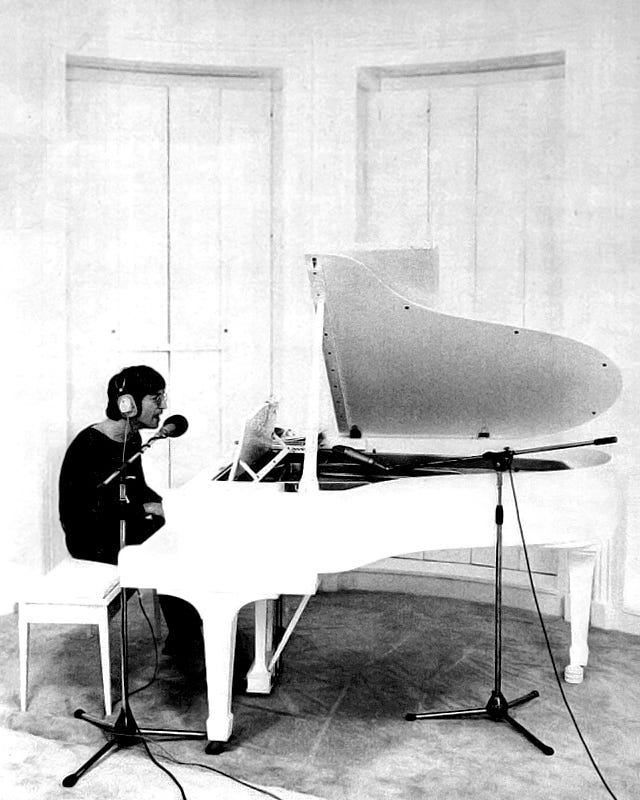
You may have seen the iconic Imagine video of John Lennon in 1971, with shaggy hair and glasses perched, singing 'Imagine' from his 20,000 sq. ft. Tittenhurst Park mansion—a Georgian-style manor with numerous bedrooms, sitting rooms, libraries, ornate staircases, and extensive cellars and attics—typical of 18th-century English aristocratic homes. Of his elaborate "white room,"—his white musical sanctuary, featuring white walls, white curtains, a white shaggy carpet under a white Steinway grand piano, and sparsely furnished with white furniture for his interviews and photo shoots. All of this is situated on a 72-acre sprawl that can fit 54 and a half American Football Fields. Imagine That!
The lyrics dream of "no possessions… no countries… no religion too," with "living for today" tied to a world without heaven or hell. But here's the absurdity: people on the street are already living for today, fighting to make it to tomorrow—Lennon's notion that removing afterlife beliefs would somehow liberate them feels detached, as if their survival isn't their daily reality. Yet he preaches this from a fortress of wealth, with gold records and his iconic "Gypsy Rolls", a 1965 Rolls-Royce Phantom V, which he later painted in bright psychedelic colors. Lennon's luxury beliefs may look beautiful in theory, but are hollow in practice. For people, "no possessions" with the stark reality of an eviction looming just a few unpaid bills away, or the beat-up car with worn-out tires they rely on to get to a job they're praying won't vanish due to layoffs or economic hardship. As if everyone giving up their possessions would end greed and hunger, when in all likelihood, lead to a dystopian modern version of Lord of the Flies. Lennon is not joining their struggle; he's insulated by privilege. Imagine's idealism masks a disconnect only the rich and elite can afford.
Steely Dan's Only a Fool Would Say That: The Man-on-the-Street Reality Check
Steely Dan, the jazz-rock duo of Donald Fagen and Walter Becker with a knack for cutting through nonsense, answered Imagine's call. Their 1972 song "Only a Fool Would Say That" is a man-on-the-street jab at utopian dreamers like Lennon. The lyrics drip with sarcasm: "A world become one of salads and sun / Only a fool would say that." They mock the idea that you can wish away reality with feel-good fantasies. Steely Dan's grounded perspective exposed a crucial aspect of luxury beliefs, highlighting the privileged disconnect between preaching ideals and not living them. Steely Dan chides John Lennon to imagine something totally different.
"Imagine your face there in his place,
Standing inside his brown shoes.
You do his nine-to-five,
Drag yourself home half alive,
And there on the screen, A man with a dream"
What's more, Steely Dan had a better understanding of the human condition than Lennon, even if it was shaped by the post-modern Beat writer William S. Burroughs' dark, surreal vision of human behavior, with desire, violence, and moral chaos lurking beneath civility.1 Their metaphorical line, "Anybody on the street has murder in his eyes," suggests that human nature at its core was inherently corrupt. As young twenty-somethings, Fegan and Becker had been grinding in the NYC music scene. They had seen the dark underbelly of urban life, giving them a raw, unfiltered view of life.
Not letting up, they accuse Lennon, "You feel no pain." continuing the theme of his disconnect, who's insulated from the pain and struggle of everyday life of the "man on the street" due to his privilege and blind optimism. And finally, the young Steely Dan twenty-somethings, ten years junior to the Beatles icon, wrily quips, "You are younger than you realize." They already understood something that Lennon didn't. That with age and experience, you no longer see the world through the rose-colored spectacles of idealism. To sum up, their man-on-the-street Truth reflects the daily grind of ordinary people, showing that elite grandstanding overlooks the real struggles beneath the surface. Steely Dan's dismantling of Lennon's luxury beliefs sets the stage for examining how we still see the same types of patterns in today's elite-driven ideas. Today's virtue signaling among the cultural elites often comes at the expense of the working class and the poor.
Luxury Beliefs in Action: From Family to Policing to Poverty
Luxury beliefs thrive on elite hypocrisy, preached from ivory towers but hitting hardest on the ground. The wealthy, cultural intellectuals of the day often downplay the importance of the traditional mom-and-dad family, while promoting more fluid family structures as the progressive way forward. Yet as Rob Henderson powerfully notes, these same elites quietly prioritize stable two-parent homes and traditional households for their own children, along with private tutors and pathways to Ivy League schools. Many of the less privileged, who lack the family stability of a two-parent home to rely on to escape poverty, bear the cost. Two-parent stable homes correlate with better outcomes, but dismissing them undermines what kids need most to thrive.
For three decades, I walked alongside at-risk teens caught in the grind of gangs and drug-dealing, kids who've seen more pain and violence by 16 than most see in a lifetime. I lived on the same streets as them, played basketball with them, sat on their porches, and listened to their stories. Lennon's Imagine—with its "no possessions" and "no religion" dream—would've gotten a hard eye-roll from them. They didn't want a world without an afterlife; they clung to hope for something beyond their daily survival. They weren't dreaming of giving up possessions either—they wanted nice things, a stable place to call home, not the chaos of eviction notices or bullet-riddled streets. Deep down, what they craved most was a stable two-parent family with a loving mother and father. Adverse Childhood Experiences—broken homes, absent dads, abuse—stacked the deck against them. So they created their own families in gangs, a broken version of the love and loyalty they longed for. Good-paying jobs? They wanted those too, but with no social connections, few role models, and a world that felt walled off, with no realistic options except to sell drugs to supplement their lower wage income at a fast-food joint. These kids weren't buying Lennon's utopia—they envied the stability and opportunity the rest of us take for granted, the very things luxury beliefs dismiss as outdated.
Or consider "Defund the Police," a 2020 moral stance pushed by affluent progressives. After the George Floyd murder, A 2021 Gallup poll revealed that nearly 80% of Black Americans, some of whom lived in high-crime areas, view police presence as indispensable to their safety. This finding highlights the challenges these communities confront, setting them apart from residents in secure, gated neighborhoods. Many (not all) Defund the Police strategies leave vulnerable communities exposed, ignoring their need for safety.2 And while the vast majority of us who have lived in high-crime neighborhoods oppose aggressive police tactics such as stop-and-frisk, we desire community policing, hiring more police officers who build relationships of trust with the community. The foot patrols, community forums, and partnerships with nonprofits and social services foster collaboration among neighbors, which inevitably results in more residents reporting crimes and sharing information about suspects, leading to reductions in violent crime and improved relationships between law enforcement and the community.
Then there's poverty: elites who champion redistributing wealth, which sounds noble, but John M. Perkins warned in With Justice for All that "in six months, that money will be back in the hands of the rich" who own all the assets—land, housing, businesses, and control the systems—while the poor stay trapped without the development of long-term assets of their own. These beliefs may win praise from fellow culture-makers, but they divert attention from effective solutions that stabilize at-risk communities, such as re-establishing marriage and the two-parent family as the social ideal while empowering the gifts, skills, and resources of local residents to address social problems and strengthen their community. It focuses on identifying and harnessing existing assets—such as individual talents, community networks, local institutions, and physical resources—rather than concentrating on deficits or needs. This leads to leveraging social capital with an array of institutions that lead to jobs and skills training and living wage employment, pathways to homeownership, partnerships with banks to create Individual Development Accounts—all of which leads to the development of long-term assets and equalizing the playing field in the free-market economy—proven strategies that can genuinely uplift individuals and communities at risk from the inside-out. As an evangelical Christian, I also can't overstate the vital role of a moral foundation formed by faith communities that drives all these activities, which we call "Christian Community Development." Imagining "no religion or God" in helping create a more just world is like crafting a sleek, powerful pickup truck, but leaving the gas tank empty. It's built to move, but won't go anywhere. By favoring ideals over reality, luxury beliefs don't improve poverty and crime in the long term, but rather leave those on the ground to bear the cost of the cultural elite's socialist dreams for the poor and working class.
Conclusion: Dreams Grounded in Reality
Lennon's 'Imagine' is a hypnotic yet hypocritical luxury belief, sung from a privileged position that shields him from its costs. Steely Dan's man-on-the-street truth in "Only a Fool Would Say That" and voices rejecting "Defund" or valuing family stability expose the flaws. From misjudging street survival to promoting today's impractical fixes for poverty, luxury beliefs hinder real progress by favoring utopian ideals over proven solutions from the streets. I am all for dreaming among the stars, but also keeping our feet on solid ground—blending a faith-fueled hope with practical steps that lift everyone, not just the wealthy elite who, like Lennon, imagine a world without reality.
While Burroughs’ view of inherent human evil shares surface similarities with original sin and total depravity—both see humans as naturally inclined toward wrong—Christianity frames this as a corruption of the God-given imago Dei, with a clear path to redemption through grace through faith in Jesus Christ. Burroughs, however, sees no divine origin or redemptive hope, only a struggle against an inherently flawed existence. The Christian view holds that humans, though fallen, are never beyond God’s image or saving power.
Much of the “Defund the Police” debate revolves around how one defines the phrase. Do they mean stripping the police forces of the funds in order to abolish the police because they believe they are inherently racist? (the view that receives the most media attention) Or does it mean reallocating resources and the police force so that law enforcement don't have to act as mental health social workers as part of their job description? In most urban communities, some of the police resources and manpower are used to deal with mentally ill (i.e schizophrenia, severe bi-polar) and drug addicted homeless that loiter, panhandle, or urinate/defecate in public. Can social workers handle some of these issues in partnership with the police so that they don't need to mobilize nearly as many police officers to deal with these petty crimes? Or does it refer to demilitarizing the police of its upkeep of military and tactical war equipment and armored personnel carriers that it received from the Department of Defense after the first Iraq war? In my 30+ years of living and doing urban ministry in high-crime infested neighborhoods, I can confidently say that there is absolutely no justification for police departments and their SWAT teams having armored personnel carriers. I've personally seen multiple VICE squads in my neighborhood take down armed drug dealers and even arms dealers without military issued equipment and were very effective. The problem is that conservative media pundits and politicians broad-brush everyone into a "police-abolitionist" view of "Defunding."I believe that community policing is the best, time-tested strategy of reducing crime in urban communities and believe in increasing police budgets in order for community policing to be successful.